


On October 24, 2025, Politico reported the Israeli-U.S. solar geoengineering startup Stardust Solutions would receive $60 million from Lowercarbon Capital and other Silicon Valley philanthropies and investment firms. This announcement renewed discussion about who funds solar geoengineering and who receives this funding. Scientists have long argued that researching these technologies may enable their use. Funding thus raises the question of whose interests are served by moving closer to “deployment” of solar geoengineering, and ultimately, by pushing back or avoiding decarbonization altogether.
In this post, we summarize our recent report Who Funds and Who Pays? where we look at who funded solar geoengineering projects and who received these funds between 2020 and 2025, which updates the 2023 study by Surprise and Sapinski.
We used the Lexis Uni business database, past publications and web searches to build a database of 43 funders and 166 funding recipients. When available, we noted amounts distributed and the number of payments distributed or received by each organization. As data collection ended in September 2025, our report includes neither the recent Stardust funding nor Politico’s additional December 2025 reporting.
Our research reveals that:
1. Total funding increased over tenfold between 2020 and 2025. The amounts of funding we know about went from less than $6 million in 2020 to $30 million in 2024, and then to a whopping $60 million in 2025 (in constant 2024 dollars). Adding the latest Stardust Solutions funding amount doubles the total known funding for 2025 to $120 million.
2. Private philanthropic organizations comprise over half the funders. Private investors like venture capital funds come second at just over 20%, and governments are a far third, with less than 12%.
3. Eighty-three percent of the funders and 46% of the recipients are based in the US and the UK. Just over a quarter of recipients are in countries outside the rich core, spanning all continents. Among the latter, almost all receive funding from the Degrees Initiative or ARIA—the UK-based Advanced Research and Invention Agency, which started distributing major funding to solar geoengineering research in 2025. Multiple recipients received funding from both, but the amount of funding is not known for grants from the Degrees Initiative.
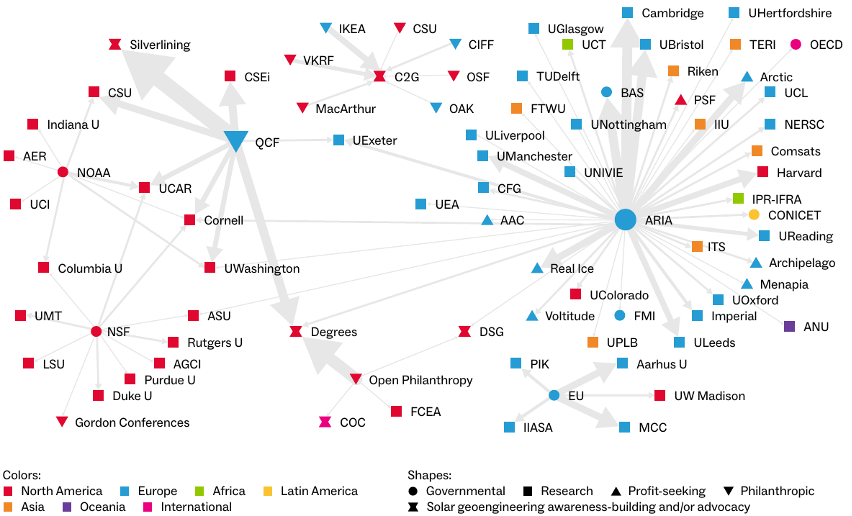
Figure 1. Some funders and recipients of solar geoengineering funding (known monetary value)
4. Almost three-quarters of funding recipients conduct research. About two-thirds of funded research involves modeling—running computer simulations to understand the effects of different types of solar geoengineering, particles, and spraying areas and methods. Indoor and outdoor experiments are also conducted to understand the properties of various aerosols. Those conducting outdoor experiments—all of them funded by ARIA—insist no release of material takes place. Finally, a small amount of research is conducted on the governance and ethics of solar geoengineering.
5. Private money supports awareness and advocacy groups, whereas public funds almost exclusively support research. Private philanthropy, venture capital, and other for-profit organizations also directed over a quarter of their payments to groups we classified as raising awareness about or advocating in favor of solar geoengineering.
6. Most private funders made their money in the tech sector. We list all major private funders in the table below. We find a common profile: billionaires or multi-millionaires who amassed their fortune in developing or investing in high technology, most of them based in Silicon Valley, California. Top funders include Facebook co-founder Dustin Moskowitz’s foundation Coefficient Giving (formerly Open Philanthropy), and other Facebook-linked foundations and venture capital firms. Other Silicon Valley figures include Chris Sacca of Lowercase Capital, a venture capital firm that invested in Twitter, Uber, and Instagram; the co-founders of cryptocurrency infrastructure company Ripple; and Microsoft’s Bill Gates, a longtime supporter of solar geoengineering. Outside Silicon Valley, we find similarly oriented philanthropies like the Pritzker Innovation Fund, headed by Hyatt Hotels heir and Ecomodernist Manifesto co-author Rachel Pritzker, as well as the Quadrature Climate Foundation and the Simons Foundation, both hedge funds that use automated trading systems. More established and generalist foundations like the Spitzer Charitable Trust, the Grantham Foundation and George Soros’ Open Society Foundations provide more marginal funding.
Table 1. Main private funders of solar geoengineering, 2020-2025
| Funder | Type | Location | Key individuals | Fortune companies | Source of fortune | Number of recipients |
| LAD Climate Fund | Investment | San Francisco, US | Larry Birenbaum, Andrew W. Verhalen, David A. Schwartz | Cisco Systems Matrix (venture capital) | Technology startup, Investment | 16 |
| Quadrature Climate Foundation | Philanthropy | London, UK | Greg Skinner & Suneil Setiya | Quadrature Capital | Investment in high tech and fossil fuels | 8 |
| Coefficient Giving (previously Open Philanthropy) | Philanthropy | San Francisco, US | Dustin Moskowitz, Cari Tuna, Holden Karnofsky | Meta/ Facebook, Asana | Technology startup, Investment | 5 |
| Cohler Charitable Fund | Philanthropy | US | Matt Cohler | LinkedIn, Meta/ Facebook, Benchmark Capital Advisors | Technology startup, high-tech investment | 4 |
| Outlier Projects | Philanthropy | Palo Alto, US | Mike Schroepfer | Meta/ Facebook | Technology startup | 4 |
| Gigascale Capital | Venture capital | Palo Alto, US | Mike Schroepfer | Meta/ Facebook | Technology startup | 3 |
| Astera Institute | Investment | Berkeley, US | Jed McCaleb | Ripple (cryptocurrency) | Technology startup | 3 |
| Navigation Fund | Philanthropy | Berkeley, US | Jed McCaleb | Ripple (cryptocurrency) | Technology startup | 3 |
| Crankstart | Philanthropy | San Francisco, US | Michael Moritz | Sequoia capital | High-tech investment | 3 |
| Amazon | Corporation | Seattle, US | Jeff Bezos | Amazon | Technology startup | 2 |
| Bernard and Anne Spitzer Charitable Trust | Philanthropy | New York City, US | Bernard Spitzer | Spitzer Engineering | Real estate | 2 |
| Gates Foundation | Philanthropy | Seattle, US | Bill Gates | Microsoft | Technology startup | 2 |
| Clean Break Fund (previously Larsen Lam Climate Change Foundation) | Philanthropy | San Fancisco, US | Chris Larsen | Ripple (cryptocurrency) | Technology startup | 2 |
| Open Society Foundations | Philanthropy | New York City, US | George Soros | Soros Fund Management | Investment | 2 |
| Pritzker Innovation Fund | Philanthropy | US | Rachel Pritzker | Hyatt Hotels, Marmon Group | Tourism, manufacturing | 2 |
| Grantham Foundation | Philanthropy | Boston, US | Jeremy Grantham | GMO LLC | Investment | 1 |
| Lowercarbon Capital | Venture capital | San Francisco, US | Chris Sacca | Lowercase Capital | High-tech investment | 1 |
| Individual investor | Individual | San Francisco, US | Bill Trenchard | LiveOps, Jump Network | Technology startup | 1 |
| Individual investor | Individual | San Francisco, US | John Wolthuis | Twilio | Technology startup | 1 |
| Simons Foundation | Philanthropy | New York City, US | James Simons | Renaissance Technologies | Investment | Multiple |
Hence, aside from governments of core countries, those funding solar geoengineering are predominantly individuals who made their fortunes in the high-tech sector and display a techno-optimist outlook. Some public statements capture this outlook, which seems shared among Silicon Valley figures:
- “An energy breakthrough is the most important thing” but solar geoengineering is “an insurance policy [to] buy us 20 or 30 years to get our act together” (Bill Gates, 2010).
- “We have no opportunity for survival on this planet unless you reflect back sunlight” (Chris Sacca, 2023).
- “We do need way more energy in the world than I think we thought we needed before […] I still expect, unfortunately, the world is on a path where we’re going to have to do something dramatic with climate, like geoengineering, as a Band-Aid, as a stop gap” (Sam Altman, 2024).
All three treat solar geoengineering as a necessity, implicitly or explicitly rejecting the possibility of a world in which energy use declines. Beyond the obvious risks in orienting research and funding in a certain direction, they link energy demand to the perceived need for solar geoengineering, candidly revealing how it protects their own economic interests: their need for more energy to power the server farms that run the internet, Facebook, AI, cryptocurrency, and other high-tech sectors where much of today’s economic growth is concentrated.
High-tech’s energy demand is very difficult to meet other than by fossil fuels. Ergo, short of a speculative energy breakthrough, solar geoengineering is necessary so that more fossil fuels can be burned to support the direct interests of the high-tech billionaires funding it. High-tech companies are poised to become the largest companies in the world; their founders and executives have become part of the ruling elite, and strive to lead it. Climate change is a class issue, and solar geoengineering an instrument of class power: a set of high technology-based strategies to protect the source of the wealth of its promoters, who depict their own interest as that of all humanity.
_____
Jared Sanborn is a PhD candidate in sociology at the University of Utah. He is interested in the political economy of social structures, science, and technology. His focus is on how those human dynamics affect interactions with the non-human world.
J. P. Sapinski is Associate Professor of Environmental Studies at Université de Moncton, in Canada. He is interested in how the structures of capitalism and corporate power mediate the socio-ecological metabolism, and how we can transform and decolonize this relationship to make it just and sustainable